
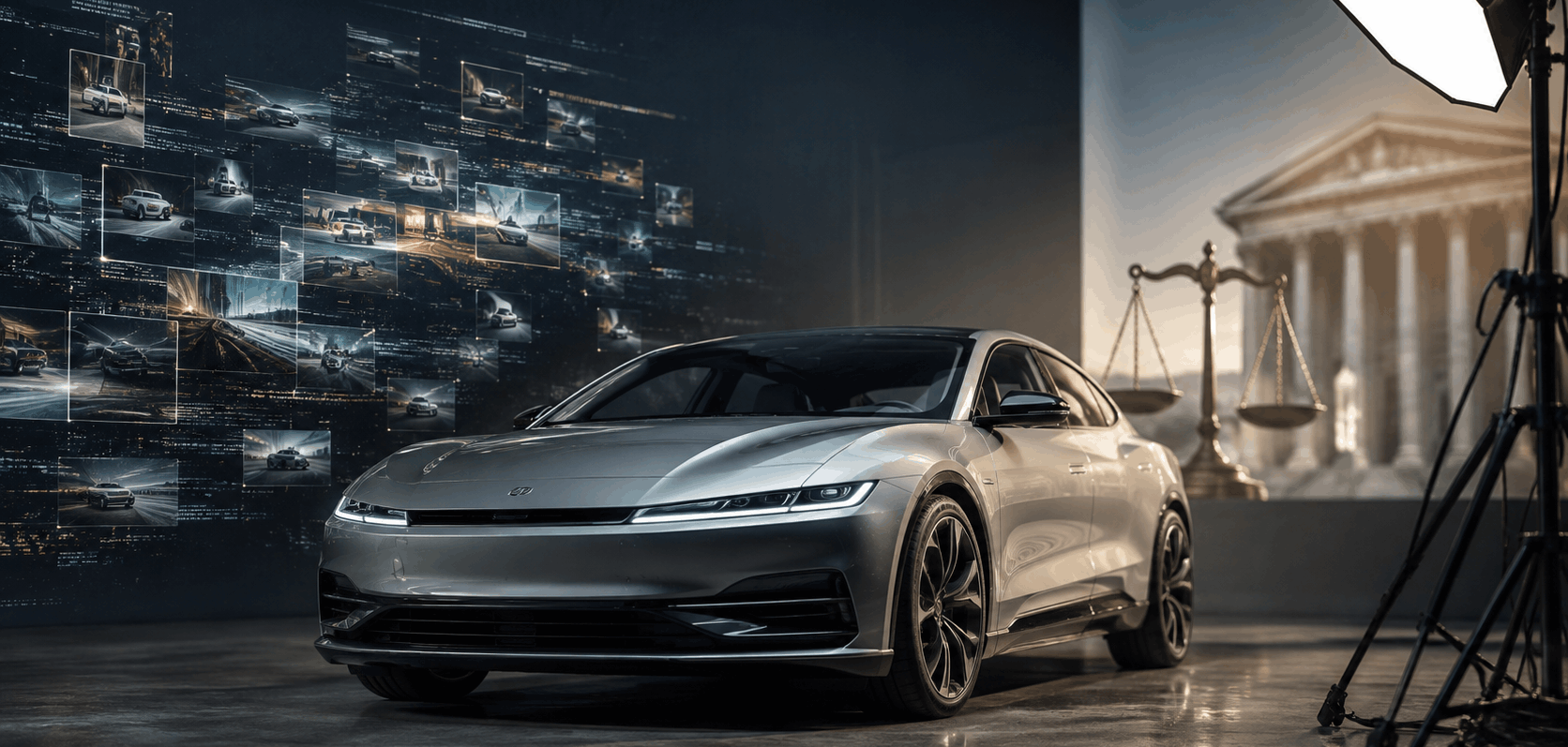
EVOX v. Midjourney: The Copyright Case That Could Put AI Training Under a Brighter Spotlight
Published 15 September 2026
There’s a particular kind of photograph you’ve almost certainly seen when looking at cars online. The vehicle sits against a flawless background. Every curve is crisp. Not a speck of dust anywhere. The lighting looks effortless, although creating it was probably anything but.
Many of those images come from EVOX Productions®, a specialist automotive photography company whose work has been licensed by manufacturers, dealerships and automotive websites for decades.
Now EVOX says that some of those carefully produced photographs helped train Midjourney® (an AI image generator) without permission.
On 30 July 2026, EVOX filed a copyright lawsuit against Midjourney in the U.S. District Court for the Central District of California. The case, EVOX Productions LLC v. Midjourney, Inc., is brand new. No court has decided whether EVOX’s allegations are true, and Midjourney has not yet had its day in court. As of 1 September 2026, Midjourney had waived formal service of the lawsuit and was due to respond to EVOX’s complaint by 28 September. The court has not yet issued any substantive ruling.
Still, the complaint deserves attention.
For website owners, marketing teams, agencies and anyone using AI-generated imagery commercially, this isn’t simply another skirmish between a photographer and a technology company. It goes directly to one of the biggest unanswered questions surrounding generative AI: What happens when copyrighted images are used to teach a machine how to create new ones?
This goes directly to one of the biggest unanswered questions surrounding generative AI …
What EVOX Claims
EVOX describes itself as a major creator and licensor of automotive photography. According to its complaint, it has photographed nearly every commercially available automobile make and model sold in the United States since 2000. It also says it owns valid copyright registrations covering more than a million images.
The complaint identifies 103,957 registered EVOX images allegedly present in the LAION-400M and LAION-5B datasets. The LAION datasets are vast, publicly accessible collections that pair images with accompanying text gathered from across the web. Developed by the German non-profit Large-scale Artificial Intelligence Open Network, they have been widely used as training resources for major generative AI systems.
EVOX alleges that Midjourney obtained copies of its photographs … then used them to develop and train its image-generation technology.
The complaint identifies 103,957 registered EVOX images allegedly present in the LAION-400M and LAION-5B datasets. The LAION datasets are vast, publicly accessible collections that pair images with accompanying text gathered from across the web. Developed by the German non-profit Large-scale Artificial Intelligence Open Network, they have been widely used as training resources for major generative AI systems.
EVOX alleges that Midjourney obtained copies of its photographs from sources identified through LAION datasets and other online sources, then used them to develop and train its image-generation technology. These remain allegations, not established facts.
EVOX’s complaint contains three broad types of claims:
- direct copyright infringement connected with AI training
- contributory copyright infringement
- alleged violations of Section 1202(b) of the Digital Millennium Copyright Act, which concerns copyright management information
That last point may make this case particularly interesting.
The Watermark Question
Copyright disputes involving AI often drift quickly towards one familiar phrase: fair use. EVOX has added another ingredient.
The company alleges its images contained copyright management information, commonly called CMI, including watermarks, credit lines and identifying metadata. EVOX further alleges that Midjourney deliberately removed or altered this information while processing images for training. The complaint includes examples of EVOX branding on automotive photographs and argues that Midjourney’s preprocessing methods could target watermarked material.
If the evidence supports that allegation, the dispute could extend beyond whether training an AI model on copyrighted material constitutes fair use. It raises a more pointed question: What happens if copyright information was deliberately removed before copyrighted material was used?
Under its DMCA claim, EVOX is seeking statutory damages of up to $25,000 for each violation of Section 1202(b), subject to what it can prove and what the law permits. It’s also seeking damages and profits for alleged copyright infringement, together with injunctive relief and other remedies.
Those numbers make for dramatic headlines, but they shouldn’t be mistaken for money EVOX has already been awarded. At this stage, the scoreboard still reads zero to zero.
The Question of AI-Generated Copies
Training isn’t the whole story. EVOX also alleges that Midjourney can generate automotive images incorporating “protected expression” from its photographs. The complaint says EVOX compared its original images with Midjourney outputs and argues that some results reproduce the expression created through its photographic choices.
That raises a different legal issue. An AI system might learn from millions of images without routinely producing recognizable copies of any one of them. Alternatively, it might generate something close enough to a protected work to raise questions of substantial similarity.
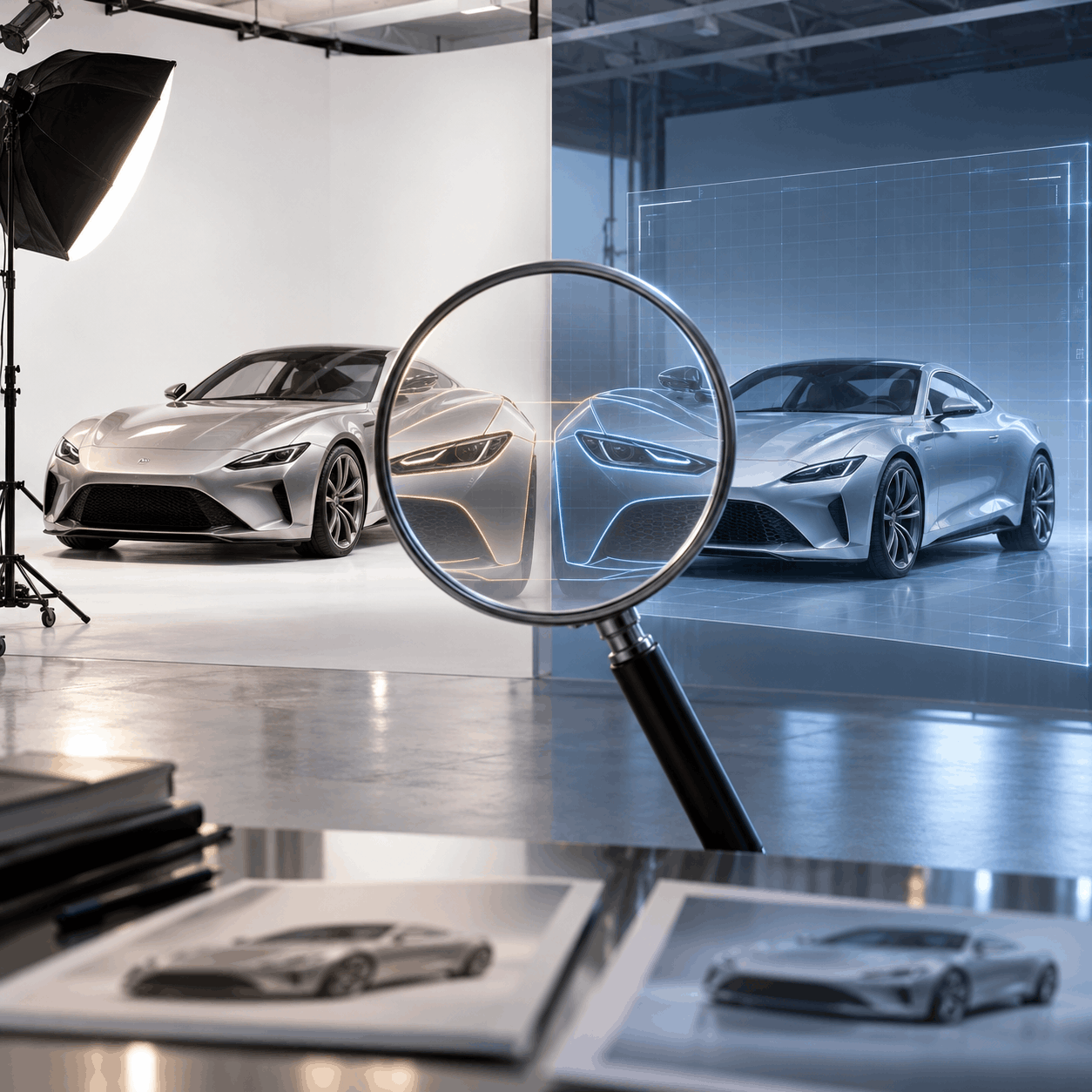
When an AI-generated image looks a little too familiar, the legal questions begin.
That’s why statements such as “AI training is legal” or “AI training is copyright infringement” are too simple for the reality courts are still figuring out.
Have Courts Already Ruled That AI Training Is Fair Use?
Not quite. Generative AI companies have scored important victories, but the developing case law depends heavily on the evidence and circumstances of each dispute.
In Kadrey v. Meta, a group of authors alleged that Meta copied their books without permission as part of its AI training process. In 2025, a federal court ruled in Meta’s favor on the authors’ particular copyright claims, finding that they hadn’t produced enough evidence to overcome Meta’s fair-use defense. The decision wasn’t a general ruling that training AI systems on copyrighted works is always fair use.
Never assume that AI-generated images are 100% safe — unless you enjoy getting dressed up for court.
The U.S. Copyright Office has also described AI training as a fact-sensitive issue. Its 2025 report noted that copying can occur when copyrighted works are acquired and used in training, while stressing that fair use must be assessed in context. It also recognized that licensing markets may matter, particularly when copyright owners already license their work commercially.
That point could be significant for EVOX. Its business isn’t merely creating beautiful photographs. It also licenses them.
Why the Licensing Market Matters
Imagine you run a marketing agency and need a polished photograph of a particular vehicle. Traditionally, you might license an existing professional image. Now an AI service can produce a convincing alternative in seconds.
For marketers, that may look wonderfully efficient. For a photography company whose business depends on licensing images, it looks very different.
EVOX argues that Midjourney’s product competes with its licensing market because customers can generate automotive imagery instead of paying to license professionally produced EVOX photographs.
Whether that competition amounts to legally relevant market harm will be for the court to examine. But it illustrates why the AI copyright debate isn’t only about robots versus artists. It’s also about markets, ownership and permission.
The answer is being written, one lawsuit at a time.
What Should Businesses Using AI Images Do Now?
There’s no need to unplug every AI tool in the office and send the marketing department back to clip art. There is, however, good reason to treat AI-generated images with the same seriousness you’d give any other visual asset.
Start by recording where each image came from. Note whether it was photographed in-house, purchased from a stock provider, supplied by an agency or generated using an AI platform. Keep the license, receipt or terms that applied when you obtained it.
There is, however, good reason to treat AI-generated images with the same seriousness you’d give any other visual asset.
For conventional images, don’t assume that finding something online permits you to use it. Search engines can locate images. They don’t transfer copyright. ImageVerifier recommends retaining licensing documentation and checking website imagery rather than relying on memory about where a file came from.
For AI-generated images, review the platform’s current commercial-use terms and find out what protection, if any, it offers users if a third party makes an intellectual property claim.
Most importantly, don’t confuse easy to generate with risk-free to publish.
Why Website Owners Should Watch EVOX v. Midjourney
You need to know where it came from, who owns it and what permission followed it onto your website.
The immediate dispute concerns an automotive photography company and an AI developer, but the outcome could have a much wider effect.
If EVOX succeeds on important parts of its case, AI companies may face greater pressure to document training sources, negotiate licenses or rethink how copyrighted visual material is collected and processed.
If Midjourney defeats the claims, the decision could a) strengthen the legal position of AI developers using large datasets and b) clarify how far fair use reaches in image-model training. The court could also decide based on the particular facts of the case without delivering the broad, sweeping answer everyone wants.
For brands and agencies, the practical lesson is already visible. Image provenance is becoming part of ordinary content governance. Knowing what an image depicts is no longer enough. You increasingly need to know where it came from, who owns it and what permission followed it onto your website.
That’s precisely the kind of uncertainty ImageVerifier is designed to help businesses investigate. It scans website imagery, identifies potential matches and helps organizations maintain licensing information so questionable assets can be licensed, removed or replaced before an unpleasant email arrives.
The Next Chapter Hasn’t Been Written
At the time of writing, EVOX v. Midjourney is only weeks old. A complaint tells us what one side intends to prove, not who will win.
Midjourney will have opportunities to respond. The court may have to examine how the training data was obtained, what happened during preprocessing, whether copyright information was removed, how particular outputs were generated and whether EVOX can demonstrate the market harm it alleges.
We’ve reached the opening scene, not the closing credits.
In a copyright landscape being rewritten by generative AI, EVOX v. Midjourney could become one of the cases worth remembering. Watch this space. We’ll be following it as it develops.
In the meantime, scan your site images to identify potential copyright risks
Disclaimer: This content is for general informational purposes only and is not legal advice or a substitute for advice from a licensed copyright attorney. It does not create an attorney-client relationship. The authors are not responsible for inadvertent errors or omissions. Laws may change over time and vary by jurisdiction, so consult a qualified attorney regarding your specific circumstances.
Welcome to the Anti-Troll Tribe!
Thanks for exploring ImageVerifier. You’ll be the first to know once we go live. We’ll send you an email notification as soon as we’re ready. Please fill out the form below to join the waitlist.
"*" indicates required fields