
An Intro to Deepfake Technology
What deepfakes are, how they’re made and why the need for image verification
Published 19 February 2026
Deepfake. The word itself tends to conjure worst-case scenarios such as fake celebrity scandals, political interference or ruinous reputational damage that occur at warp speed. Those risks are real and deserve serious attention. But they’re not the whole story.
When knee-jerk reactions and fear dominate the deepfake conversation, it becomes harder to understand how deepfakes actually work, why they’re spreading so quickly and how creatives and website owners can respond with precision rather than panic.
Instead of fear-mongering, this article aims to do something simple and useful: One, explain deepfake technology clearly, without hype or horror, and two, show why it has become important in terms of image verification, especially for images published on websites, where public trust matters just as much as legally dotting the i’s and crossing the t’s.
Recent Deepfakes You May Have Seen
Deepfakes don’t usually announce themselves as “fake.” The most effective ones are created to look quite ordinary, like the kinds of images and videos people see every day on news sites, web pages, blogs and social media feeds. They don’t trigger suspicion precisely because they fit so naturally into familiar online environments. They feel unremarkable, and that’s the exact goal: seamless integration.
A few publicized cases show their believability:
Deepfakes don’t usually announce themselves as “fake.” The most effective ones are created to look quite ordinary.
- Non-consensual celebrity images that spread like wildfire. In January 2024, adult-themed AI-generated deepfake images of Taylor Swift circulated widely online, pushing governments, platforms and advocacy groups to respond more publicly to the impact of synthetic imagery.
- Real-time deepfake video used for fraud. In early 2024, Hong Kong police detailed a case in which scammers used a deepfaked video of colleagues during a video conference call to convince a finance worker to transfer about US $25 million. To date, the money has never been retrieved.
- Unauthorized likeness used in advertising. In late 2025, a US state lawmaker reported that a deepfake version of herself appeared in an overseas ad promoting appliances. This is an example of how synthetic media can travel across borders, languages and legal systems.
These examples span different media formats: images, video and hybrid “talking head” edits. But they share a common denominator: The distribution point, most often, is the web. The synthetic content is posted, embedded, mirrored, scraped and republished much faster than it can even be verified or removed. Warp speed.
What Is a Deepfake?
A deepfake is a piece of synthetic media (most often an image, video or audio clip) that is generated or altered using machine learning techniques so that it convincingly imitates a real person, place or event.

Sometimes, fake is obvious.
The defining feature isn’t that the media is “fake” (photos have been manipulated since the days of the darkroom), but that the alteration is driven by models trained on large datasets, allowing the output to mimic real-world patterns with striking realism.
Common examples include:
- A video where one person’s face is replaced with someone else’s.
- An authentic-looking still image of a person who never actually posed for the photo.
- Audio that reproduces a real person’s voice, saying things that they never actually said.
- Website images generated or altered to look like authentic photography, product shots, news images or user-generated content
It’s important to remember that not all deepfakes are malicious. Some are clearly labeled satire, art or visual effects. Others are used in film production, accessibility tools or to enable privacy–preserving journalism. The ethical and legal questions should hinge on context, consent and disclosure, not merely on the presence of AI.
How Deepfakes Are Made
At the technical level, most deepfakes rely on a family of machine learning systems known as generative models. Think ChatGPT, Gemini, Claude, Perplexity, Copilot, Grok and more. You don’t need to be an AI engineer to grasp the basic idea. These days, almost anyone can generate deepfakes.
1. Training on examples
The process starts with data. To generate a convincing face, for example, an AI model is trained on many images of faces (often thousands or millions), learning statistical patterns such as:
- How eyes, noses and mouths are shaped, where they’re positioned in relation to one another and how motion affects their appearance.
- How lighting affects skin tone.
- How facial expressions transition over time, not in the span of a single frame.
If the goal is to imitate a specific person, the training data may include publicly available photos or videos of that individual.
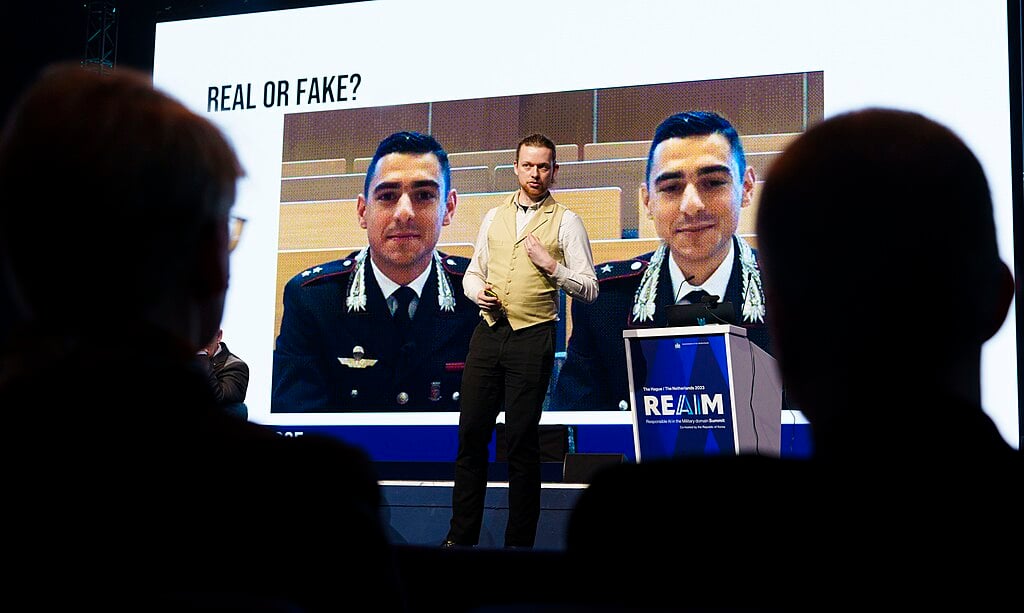
Of the two uniformed men, one is real and one is fake, but which is which?
2. Learning patterns, not copies
Crucially, modern generative models don’t store images like a scrapbook. They learn probabilities: what features tend to co-occur, how pixels relate to one another, how motion unfolds frame by frame.
This distinction matters for copyright. The output is usually not a direct copy of any single source image, but it may still raise rights issues if it reproduces a recognizable likeness or was trained on protected material without permission.
A deepfake image may raise copyright issues if it reproduces a recognizable likeness or was trained on protected material without permission.
3. Generating new media
Once trained, the AI model can generate new images or videos that fit the learned patterns. In faceswap videos, one model may analyze the source performance (expressions, movements) while another synthesizes a target face that matches those motions.
The result can be eerily realistic or obviously flawed, depending on the quality of the data, the model and the post-processing.
Why Deepfakes Look So Convincing
Deepfakes succeed not because they are perfect, but because they exploit how humans perceive images.
We tend to trust:
- Smooth motion. If motion is jerky, we instinctively consider it robotic or fake.
- Consistent lighting without sudden, unnatural changes.
- Familiar faces seen at low resolution or on small screens. The familiarity is what convinces us.
Social media compression, short viewing times and algorithmic feeds supply the rest of the smoke and mirrors. A deepfake doesn’t have to survive forensic scrutiny. It only has to pass a casual scroll.
That gap, between human plausibility and technical authenticity, is where verification becomes essential.
Deepfakes and Image Authentication
Image authentication used to focus on questions like: “Was this photo altered?” or “Is this image legitimately from the claimed time and place?”
For website operators, publishers and investigators, the stakes are high. A single synthetic or manipulated image can undermine credibility, expose a site to legal risk or mislead audiences at scale.
Deepfakes add a new question: “In reality, did this scene actually ever exist at all?”
On websites, this question becomes especially important. Images are often removed from their original context, stripped of metadata, resized, compressed or reposted across multiple domains, making visual plausibility the poor cousin to actual verification.
For site owners, journalists and investigators, this shifts authentication from a mere visual inspection to a multi-signal approach, including:
- Metadata analysis. Is there a consistent, traceable creation history?
- Provenance tools. Can the image be traced back to a trusted capture device or source?
- Model fingerprints. Does the image contain artifacts or indicators associated with known generative systems?
“I saw it with my own two eyes” doesn’t mean as much as it used to, especially if what you saw was online.
- Contextual corroboration. Are there any independent sources that can confirm the event?
Importantly, no single method on the list above should be considered a deciding factor. Authentication increasingly resembles investigative reporting rather than technical know-how. If you’re not sure whether an image you’re using is a deepfake or AI-generated, there are free online tools specifically designed to help you establish that.
Beyond Authentication, to Verification
Regardless of whether an image you display on your website is an AI-generated deepfake or not, it poses a potential legal threat either way. How?
For most businesses, bloggers and independent online creators, the majority of the images they deal with are probably the images on their websites. Whether you’re relying on AI-generated deepfake images or images sourced elsewhere, it’s important to establish that the images don’t too closely resemble any copyrighted images.
If they do, and you publish the image on your site, you’re potentially putting yourself at risk for a copyright infringement claim, resulting in demand letters and lawsuits. (Just remember that, unlike us humans, the automated copyright enforcement bots never sleep.)
If you want to know whether an image does, in fact, pose a copyright risk, you need a specialized tool.
This is where ImageVerifier comes into play. To be crystal clear, this is not a deepfake or AI image detector. This is a tool that scans your site and flags images that are potential copyright infringement risks.
This could be a person, a location, an artwork or some other visual cue. Perhaps you’re thinking, “My AI or deepfake images are safe.” Remember what we said above about the training data the AI models use to generate their output? Yup, that data may include copyrighted material. And that potentially puts you at risk.
Copyright, Consent and Likeness Rights
From a copyright perspective, deepfakes raise three overlapping questions:
1. Training data
Were copyrighted images used to train the model, and if so, under what legal theory? Were the copyrighted images licensed, fair use or something else? Does the AI model’s output too closely resemble its copyrighted training data? Courts are still working through these questions and outcomes may differ by jurisdiction.
2. Output ownership
Who owns a synthetic image? The AI model? The user who prompted it? The person whose likeness appears in it? Here, the law still lacks clarity and different countries answer this question differently.
3. Personality and likeness rights
Even if an image isn’t a copyright infringement, it may violate a person’s right of publicity or privacy, especially if it implies endorsement, wrongdoing or intimacy without consent.
This means deepfake imagery should be treated not just as a technical artifact, but potentially as a rights-bearing object tied to real people.
$25 million was lost to a deepfake scenario. To date, the money has never been retrieved.
Why Panic May Be the Wrong Response
It’s tempting to think of deepfakes as some kind of existential threat to truth. It’s easy to start thinking you can’t believe anything you see on the internet anymore. But history suggests a more measured view may be wise.
Photography didn’t end truth. It changed how truth is captured and verified. Digital editing didn’t eliminate trust. It raised the bar for evidence. Deepfakes could follow the same pattern.
The real danger is not that synthetic media exists, but that institutions fail to adapt, such as:

You know it’s fake, but at the same time, you kind of wish it wasn’t…
- Newsrooms or websites without verification standards.
- Platforms without provenance signals.
- Legal systems that lag behind our modern, technical reality.
The real danger is not the technology itself, but how it is used: when deepfakes are presented as real, when synthetic media is used to evade legitimate copyright protections and when publishers fail to assume responsibility for verifying what they display.
Fear leads to short-sighted solutions: blanket bans, over-censorship or assuming all synthetic media is malicious. It potentially results in throwing the baby out with the bathwater. Understanding the deepfake phenomenon allows for rational, logical and appropriate responses.
Final Takeaway
Deepfakes aren’t some kind of black magic and they’re not going away. They’re simply an AI product comprised of images, sounds and motion. And like every major media technology before them, they amplify both creativity and risk.
Can you imagine Star Wars, Jurassic Park, Toy Story or The Lord of the Rings without CGI (Computer Generated Imagery) or AI?
For image verification, the task is not to attempt to spot every fake by eye, but to rebuild trust through transparency, provenance and context, particularly for images found on websites, where audiences, quite reasonably, expect authenticity. For copyright and likeness rights, the challenge is to protect people without freezing innovation.
ImageVerifier can rapidly scan your site and estimate the risk level of each image. It flags at-risk images and helps you maintain a record of your licenses. This gives you the opportunity to license, replace or remove any risky images before copyright bots, fines, claims and lawsuits come knocking at your door.
Clear thinking beats fear. And in the age of synthetic media, clarity may be the most valuable tool we have.
Disclaimer: The information on this website is provided for general information purposes only and does not constitute legal advice. Nothing on this site creates an attorney–client relationship. Copyright laws vary by situation, and you should consult a licensed copyright attorney for advice regarding your specific circumstances.
Welcome to the Anti-Troll Tribe!
Thanks for exploring ImageVerifier. You’ll be the first to know once we go live. We’ll send you an email notification as soon as we’re ready. Please fill out the form below to join the waitlist.
"*" indicates required fields