
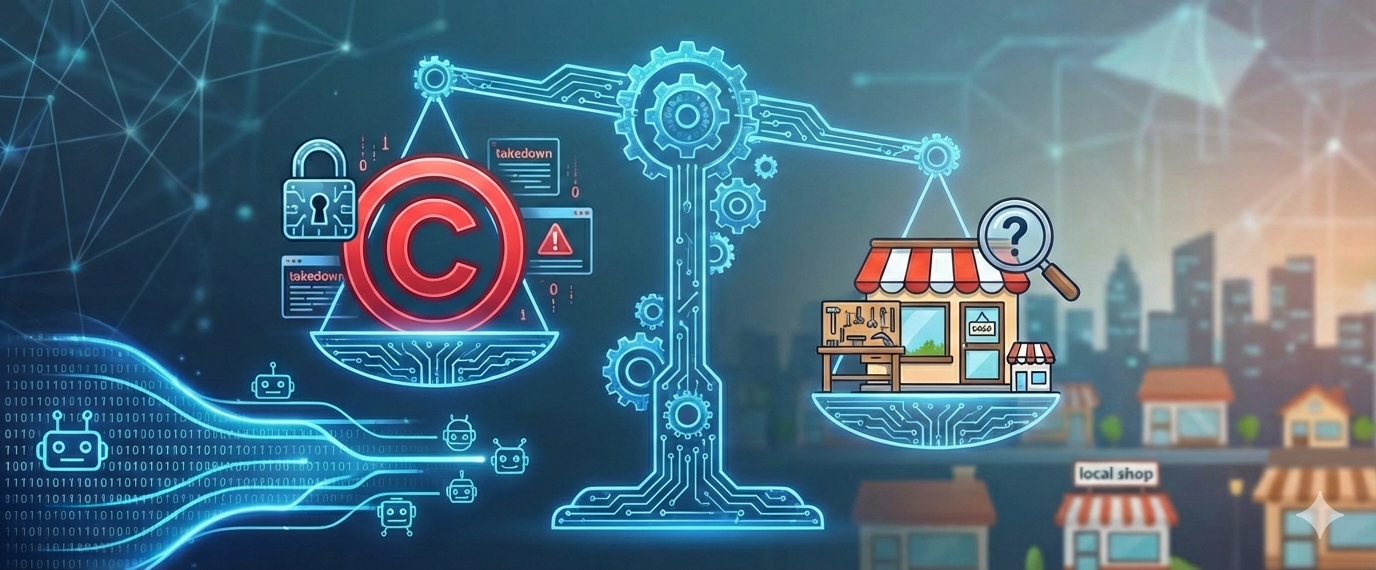
The Impact of Automated Copyright Enforcement on Small Business
Published 22 January 2026
For most small business owners, the first brutal brush with copyright law usually doesn’t occur over the phone, in a law office, or even via an ink-on-paper cease-and-desist letter drafted by legal counsel.
Instead, most commonly, it arrives as an impersonal automated email — often curt, templated and algorithmically generated — claiming that an image on your website infringes someone else’s copyright. The sender is seldom the photographer, image creator or rights holder themselves. More often, it is a third-party compliance firm operating at scale, using automated detection tools to monitor the internet for visual matches. It’s law enforcement without a human face.
It’s law enforcement without a human face.
The digital age has brought about huge changes in copyright enforcement. What was once a human-driven, context-sensitive legal process has become an automated compliance industry optimized for speed, volume and “settlement efficiency.” It’s like a money-making version of RoboCop.
While these automated systems are supposedly designed to protect creators, they’ve also created a whole new economy based on alleged legal risk — one that disproportionately affects small- and medium-sized businesses (SMBs) that lack the legal knowledge or resources to respond effectively. In other words, they don’t have savvy in-house legal counsel backed by a well-funded legal department.
The Rise of the Automated Demand
Often working on behalf of stock image companies, automated copyright enforcement relies on image-recognition bots that crawl the web, compare images against proprietary databases and flag matches with little or no human review. Once a match is detected, a demand letter (usually an email) is automatically generated and sent to the website operator, often alleging infringement and requesting payment within a short deadline.

Small businesses are a softer target than the corporate giants.
These systems, however, are not designed to evaluate legal context. They cannot reliably determine whether an image is being used under a valid license, whether the use qualifies as fair use, or whether the image resides in the public domain. Nor can they assess whether their client (usually a stock library) actually even possesses enforceable rights for that image.
Instead, they operate based on probabilistic matching and economic assumptions: that a sufficient percentage of recipients will simply pay rather than contest the claim. The word “opportunistic” comes to mind.
From a philosophical perspective, this represents a shift away from rights-based copyright management toward copyright deployed as a compliance dragnet. The law itself has not changed, but its enforcement has effectively been automated.
Why Small Businesses Are the Primary Target
The copyright enforcement machines seem to operate on a high-volume, low-friction model. Large corporations and big governments have in-house legal teams who bat away meritless claims of all kinds, whether they be claims by overzealous dissatisfied customers, their competition or what have you. Smaller operations, however, are viewed as softer targets for three specific reasons:
1. The Settlement Gap. A demand for $800 is often cheaper to pay than hiring an attorney to review and counter the claim.
2. Lack of Provenance. Many site owners can’t prove the exact source of an image — one they added to their website three years ago. Without a paper trail or an audit log, you could be defenseless against an automated claim. (More on this below.)
3. The Legal Anxiety Factor. The mere mention of things like federal court and statutory damages can be disconcerting (or even scary) to those who don’t have teams that deal with legal claims as a routine. This factor alone is often enough to cause small business owners to just pay the “fine” or accept a quick settlement, even if the alleged infringement was an innocent technical error or involved a public domain image.
Some stock libraries routinely ingest public domain images.
It’s possible that the targeting of SMBs is not entirely accidental. Automated enforcement firms may rely largely on scale as the key. They likely know that small claims can be profitable if enough recipients capitulate and pay. As a result, enforcement activity might focus on smaller or resource-limited targets rather than the corporate giants.
The “Enclosure” of the Public Domain
One of the most troubling consequences of automated enforcement is its impact on the public domain. There is a widespread misconception that public domain works are free and not subject to commercialization. In reality, current US copyright law permits anyone to reproduce, distribute and even sell public domain works.
Some stock libraries routinely ingest public domain images, allegedly adding value through curation, metadata, searchability and licensing. And, for access to those services, they charge. While some may question the ethics of this practice, it is entirely lawful. Just remember that any image definitively (legitimately) in the public domain remains free to use. Just make sure it really is a public-domain image (a topic for another article).
The Copyfraud Quandary
The act of falsely claiming copyright ownership of a work that is in the public domain is another matter entirely and is often referred to by legal scholars as “copyfraud.” In the digital age, this has become a lucrative, bot-driven business model. How does it work?
- Scraping: First, automated “ingestion” bots scrape public archives like the Library of Congress, NASA or the Smithsonian.
- Watermarking: Next, the images are automatically stamped with the company’s logo and assigned a price.
- Enforcement: Finally, “copyright trolling” or “enforcement” bots scan the internet for matches. When they find one, the system automatically generates the dreaded email or letter, imposing a fine (frequently with strong implications of more serious consequences if the fine is not paid).

Limiting bot crawling and data mining, combined with the use of an image verification tool, can help provide reassurance and peace of mind.
When a website owner is targeted for using a public domain image that is also included in a stock image library’s content, you can see how confusion could arise — even though the site owner lawfully obtained the image for free from a legitimate public domain source.
This creates what scholars describe as a quasi-enclosure of the public domain: not through legal ownership, but through technological and economic pressure.
Legal Context: Highsmith v. Getty Images
The 2016 case, Highsmith v. Getty Images, offers important insight in this area. Photographer Carol Highsmith had donated thousands of photographs to the Library of Congress, explicitly dedicating them to the public domain. Getty Images later licensed those same photographs and sent infringement demands to users — including Highsmith herself.
The federal court held that once a creator dedicates works to the public domain, they relinquish their rights and any control of future uses. While Getty could sell access to the images, neither Getty nor Highsmith could claim exclusive rights.
The case underscores an important principle: Public domain status is irrevocable and no amount of commercial repackaging can restore or establish exclusive rights. Automated enforcement systems, however, often operate as if this distinction does not exist. What does this mean for you?
You should do all you can to ensure that the image you are using is actually in the public domain. If you want to reduce your likelihood of someone winning a judgment against you for copyright infringement on something you thought was public domain, try the tips listed below.
Can I Safely Use Public Domain Images?
In the world of copyright law (including the public domain), it’s impossible for anyone to reduce their risk level to zero. But doing the following should improve your odds:
- Document the Source. Keep a screenshot of the public domain site page where you downloaded the image. This may act as your “get out of jail free” card if you receive a demand letter.
- Only Use the Public Domain Version. If you find a public domain image you wish to use, download the image directly from the source. Avoid downloading the image from others (a stock provider, for example) even though the image may be identical to the image on the public domain site. Stock library versions often contain specific watermarks or metadata that can be protected as a “derivative work.” Always use the original file from the public domain site of your choice.
The automated compliance industry is optimized for speed, volume and “settlement efficiency.”
- Provide Attribution. Although not legally necessary for public domain works, including a credit line (such as “Photo by John Doe, courtesy PublicDomainPictures.net”) can indicate to enforcement bots (and their human handlers) that you know the source of the image and that it is free to use. Most public domain sites provide an attribution line, should you wish to include it.
Proactive Defense: Protecting Your Assets
In the era of automated law, the burden of digital hygiene has shifted to the website owner. Relying on memory or “best efforts” is no longer a viable strategy. So, what do you do?
Audit your existing assets. It may sound like a pain, but the first step in self-defense is knowing exactly what is on your server. An image copyright checker can identify at-risk images, such as those that lack a clear license or have been flagged against a stock library, before a compliance bot finds them.
For businesses that produce their own original images, the risk runs in the opposite direction. Imagine that you have original photographs (for which you haven’t yet registered a copyright) on your site. Along come the bots to scrape and ingest your images. The next thing you know, you receive a copyright claim on behalf of a stock image library (for example) — demanding payment for using one of your own images!
This means that preventative measures may currently be more essential than ever.
1. Technical Deterrents: The robots.txt File
If you are a creator, how do you prevent your work from being sucked into these ingestion machines? One way is to talk to the bots in their own language.
At the most basic level, website owners may signal their intent to restrict crawling by configuring their robots.txt file with something like the following:

Preventative measures may currently be more essential than ever.
While not legally binding, this instruction communicates clear intent. Generally, most reputable crawlers should comply and any evidence of their noncompliance may later serve as evidence of bad faith. As with anything in life, there’s no guarantee that this will work in all situations, but it’s probably worth the relatively minor expense of adding such simple code.
2. The Emerging Standard: IPTC “Data Mining” Metadata
As of late 2025, the International Press Telecommunications Council (IPTC) expanded its metadata standards to include explicit “Data Mining” permissions. These machine-readable fields allow creators to signal whether their content may be ingested for training, indexing or licensing. The suggestion is to embed “No Data Mining” and “No AI Training” tags into your images. It’s the digital version of “Keep Out!”
Use tools such as Adobe Bridge, Lightroom or ExifTool to set the Data Mining property to Prohibited. The reasoning behind this move is that most major stock agencies increasingly rely on this metadata to filter submissions and reduce future disputes.
3. Maintain a Compliance Vault
When you license or download an image, even a free one, save a timestamped screenshot of the source page and the license agreement. Save all your documentation in one searchable, secure location and update it whenever you add a new image to your site. This paper trail is your documented, dated evidence if an automated demand letter ever arrives.
4. Strategic Watermarking as Evidence
Although visible watermarks are often criticized for aesthetic reasons, they may serve as important evidence. A watermark that includes your business name and original URL establishes provenance. If your image later appears in a stock catalog or enforcement database, your original watermark may nullify claims of a stock library’s ownership.
What To Do if You Receive a Demand Letter
Note: What follows is not meant as legal advice and is not a substitute for the advice of legal counsel who is familiar with your exact situation.
So, what do you do when that innocuous ping of an email sliding into your inbox signals the arrival of a threat? When an automated notice arrives, resist the urge to pay immediately, as there are a few things you can try before reaching for your credit card.
- Seek legal counsel from a licensed copyright attorney.
- Source Verification: Identify where you sourced the image and under what terms you obtained it. (This is why you need the above-mentioned Compliance Vault.)
- Reverse Image Search: Tools like Google Lens may reveal instances of the image that predate the claimant’s alleged rights.
- Preserve Evidence: Capture time-stamped screenshots of public domain sources or license pages that predate the claim. Such documentation alone may resolve an automated claim.

Carol Highsmith’s public domain image that triggered an infringement demand letter and lawsuit.
- Preserve Evidence: Capture time-stamped screenshots of public domain sources or license pages that predate the claim. Such documentation alone may resolve an automated claim.
- Copyright Validation: Your attorney may recommend that you request the claimant’s copyright registration number. Under current US law, for example, statutory damages are only available if the claimant has officially (and timeously) registered a copyright on the image.
Final Thoughts: From Sitting Duck to Informed Owner
In the digital world, copyright risk has become ever-present, potentially embedded in our everyday lives rather than merely occurring in cases of willful wrongdoing. Sadly, automation seems to have shifted the burden of legal literacy onto users, particularly small businesses.
Knowledge, however, potentially remains the most effective defense. By combining technical safeguards, ethical sourcing practices and an understanding of copyright’s limits, businesses may limit risk exposure without abandoning creativity.
ImageVerifier may help you achieve peace of mind by scanning your website images and offering feedback on the risk level associated with each image, so that you know whether to remove, replace or license an image.
The goal is not to evade copyright law, but to restore balance and ensure that automation serves the law, rather than silently rewriting it.
Disclaimer: The information on this website is provided for general information purposes only and does not constitute legal advice. Nothing on this site creates an attorney–client relationship. Copyright laws vary by situation, and you should consult a licensed copyright attorney for advice regarding your specific circumstances.
Welcome to the Anti-Troll Tribe!
Thanks for exploring ImageVerifier. You’ll be the first to know once we go live. We’ll send you an email notification as soon as we’re ready. Please fill out the form below to join the waitlist.
"*" indicates required fields